Dror Maayan
2019, July
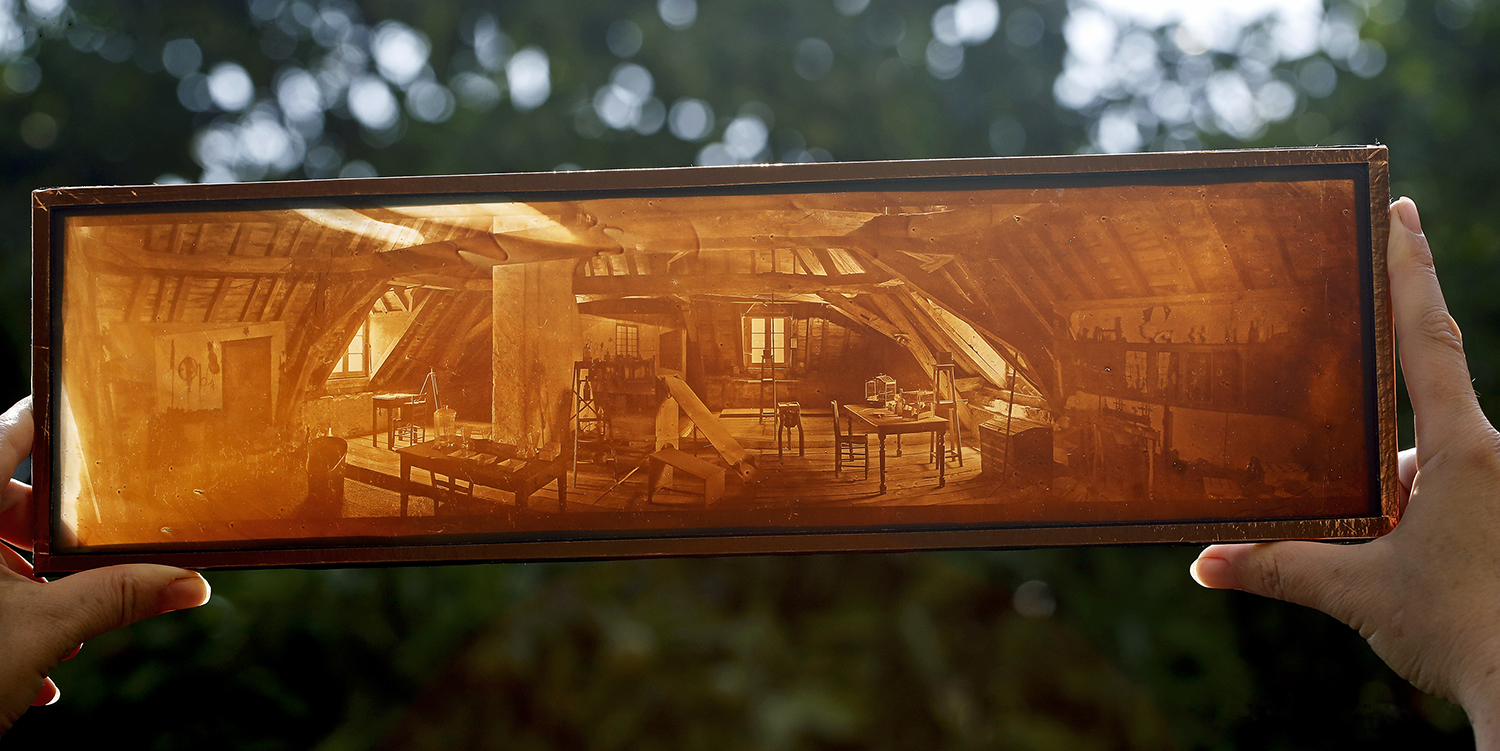
The original studio of Nicéphore Niépce house in Chalon-sur-Saone
Niepceotype
Private collection of Dror MaayanDror Maayan (2 November 2019):
The albumen on glass negative was invented in 1847 by Abel Niépce de Saint-Victor (1805-1870), a cousin of Nicéphore Niépce, the inventor of photography. Originally using starch, Niepce de Saint Victor found out that egg albumen can be used as a binder for silver iodide on glass plates (Osterman-Romer, History of Photography, 31). The process was called Niepceotype. In 1848, a positive on glass contact printing from albumen on glass (Hyalotype) was invented by Langenheim brothers, Philadelphia. Prof. Mark Osterman (GEM, Rochester, NY) states that because of the long exposure time as well as long development of plates, this process was not used for studio photography but only for field, landscapes, architecture or still-life. No photographic technique could surpass the quality and resolution of Niepceotype ever since.
Last July (2019), I had a one-month trip to France, with special emphasis on early photography. I paid a visit to Daguerre's hometown and to Nicéphore Niépce house in Chalon-sue-Saone. I was very fortunate to have a private tour and was able to visit the original studio where photography was born. On this occasion, I made the panorama photo, and upon returning home, used the negative to print this hyalotype (positive albumen on glass transparency) on 15.10.2019, using the original process invented in 1840s. Apparently, I am the only one in the world creating with this rare technique, this is according to Prof. Mark Osterman, who initiated my passion for it. During the past two years, I immerse myself in research expanding the limits of the original Niepceotype process, and now, use it as in-camera direct positive on metal (an application that was never done in the 19th century). Recently, after months of experiments, I managed to increase the speed of the original albumen technique, almost equaling it to the wet-collodion exposure time. Thus, the main obstacle of the original technique is solved, enabling me to create portraits. I find Niepceotype technology (with my improvements) highly potential and rewarding since it is a dry technique (no need for a portable darkroom and in-situ developing). Its unique beauty and super high quality of fine details are overwhelming.
I have the only 19th-century photographic studio in Israel and work in a wide range of historic techniques.
You can see more works on my website:
www.alternativestudiophotos.com LL/94409