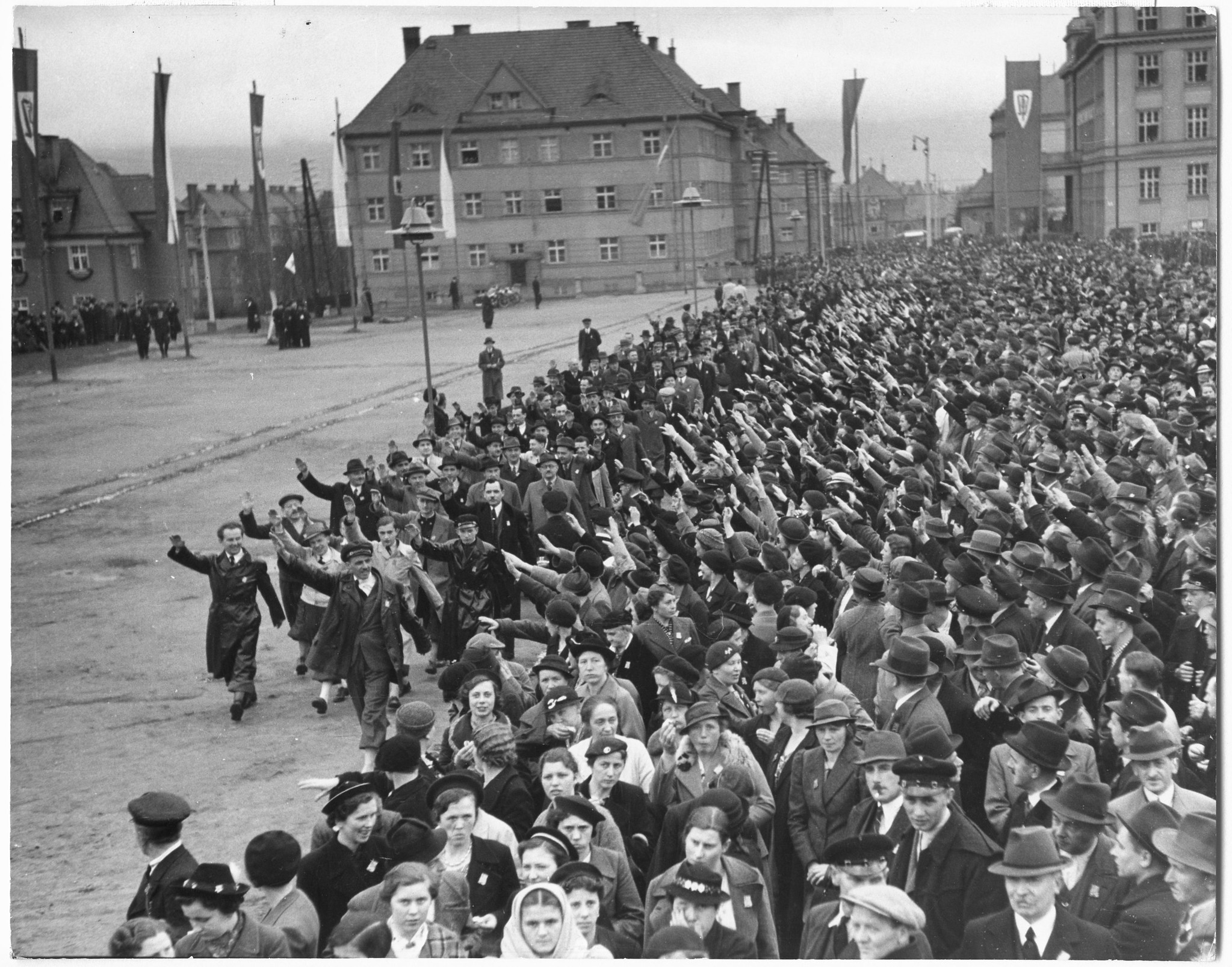
Margaret Bourke-White1938Henlein Rally, Czechoslovakia
Gelatin silver print8 x 10 in.
Archive FarmsThe Patrick Montgomery Collection, Object No. 2023.499
(Alan Griffiths, 21 June 2025) The Henlein movement refers to the Sudetendeutsche Partei (SdP), or Sudeten German Party, led by Konrad Henlein in Czechoslovakia during the 1930s. This political movement emerged from the grievances of the ethnic German minority living in the Sudetenland, a border region of Czechoslovakia where Germans made up a significant portion of the population.
Founded in 1933, the SdP initially presented itself as a moderate force seeking greater autonomy and cultural rights for Sudeten Germans. However, under Henlein’s leadership and growing influence from Nazi Germany, the party increasingly aligned with Hitler’s expansionist aims. By 1935, it had become the largest party representing Germans in Czechoslovakia, and by 1938, it was essentially functioning as a fifth column, promoting destabilization from within.
Henlein demanded full autonomy and exploited tensions between the German minority and the Czech government. These demands were used by Adolf Hitler as a pretext to pressure the Czechoslovak state. The movement played a central role in the events leading up to the Munich Agreement (September 1938), which forced Czechoslovakia to cede the Sudetenland to Germany without military resistance. After annexation, the SdP was dissolved and absorbed into the Nazi Party.
LL/130771