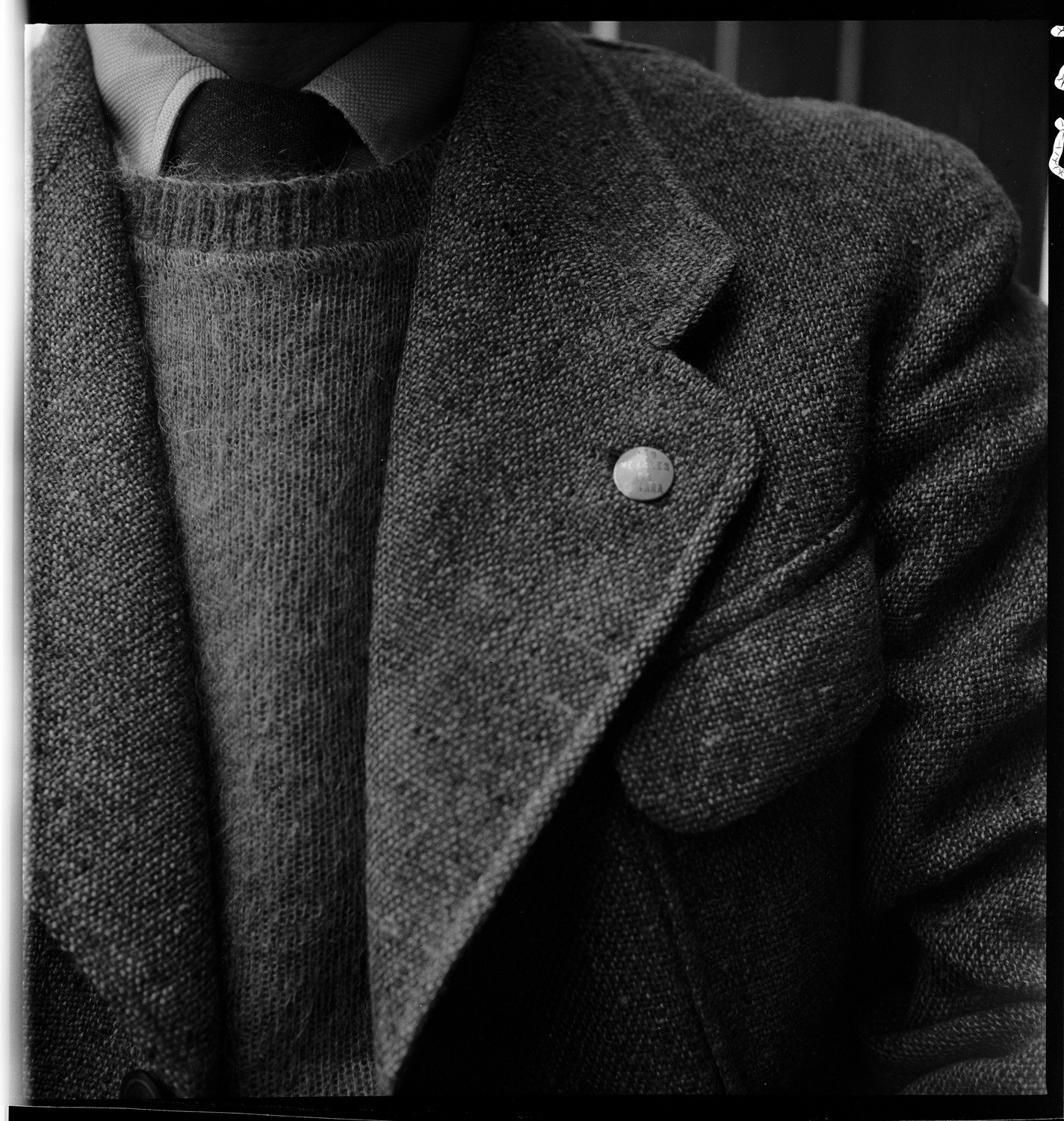
Thérèse Bonney1941Portugal: Montemor-o-Novo
Negative, nitrate film
Bancroft Library, University of California BerkeleyThérèse Bonney Photograph Collection circa 1850-circa 1955, BANC PIC 1982.111.03.0152--NNEG
(Alan Griffiths, 30 May 2026) I'd welcome input on the sgnificance of the lapel pin.
The small, circular lapel pin visible on the man's tweed suit jacket carries significant political and historical weight relative to Portugal's political climate in 1941. During World War II, Portugal was governed by a corporatist, authoritarian regime known as the Estado Novo (New State), led by Dictator António de Oliveira Salazar. Although Portugal remained officially neutral during the war, the state maintained strict social control, heavy censorship, and an extensive bureaucratic apparatus to enforce national unity and political conformity.
In authoritarian regimes of the 1930s and 1940s, wearing official lapel pins was a widespread cultural and societal expectation, serving to demonstrate regime loyalty and membership. The pin likely denotes an official association with one of the state-sponsored organizations established by Salazar's government to mobilize society, such as the Legião Portuguesa (Portuguese Legion, a state militia) or the União Nacional (National Union, the sole legal political party of the regime).
Thérèse Bonney's documentary work in Montemor-o-Novo extensively captured everyday citizens, local officials, and laborers. For a professional, merchant, or government worker, wearing the designated state lapel pin was a necessary signifier of civic compliance, patriotism, and professional standing, signaling to local authorities that the wearer was in good standing. Furthermore, during a period of widespread surveillance and political policing enforced by the regime's state police (the PVDE), visibly displaying allegiance via a subtle lapel pin acted as a passport for public spaces, providing the wearer with social safety and minimizing suspicion when traveling or working across provincial regions. By capturing this close-up shot of the man's formal attire, Bonney recorded an intimate material detail of how authoritarian politics seamlessly integrated into the ordinary dress and social fabric of wartime Portugal.
LL/132347