Unidentified photographer / Unidentified maker
1860-1867 (made)
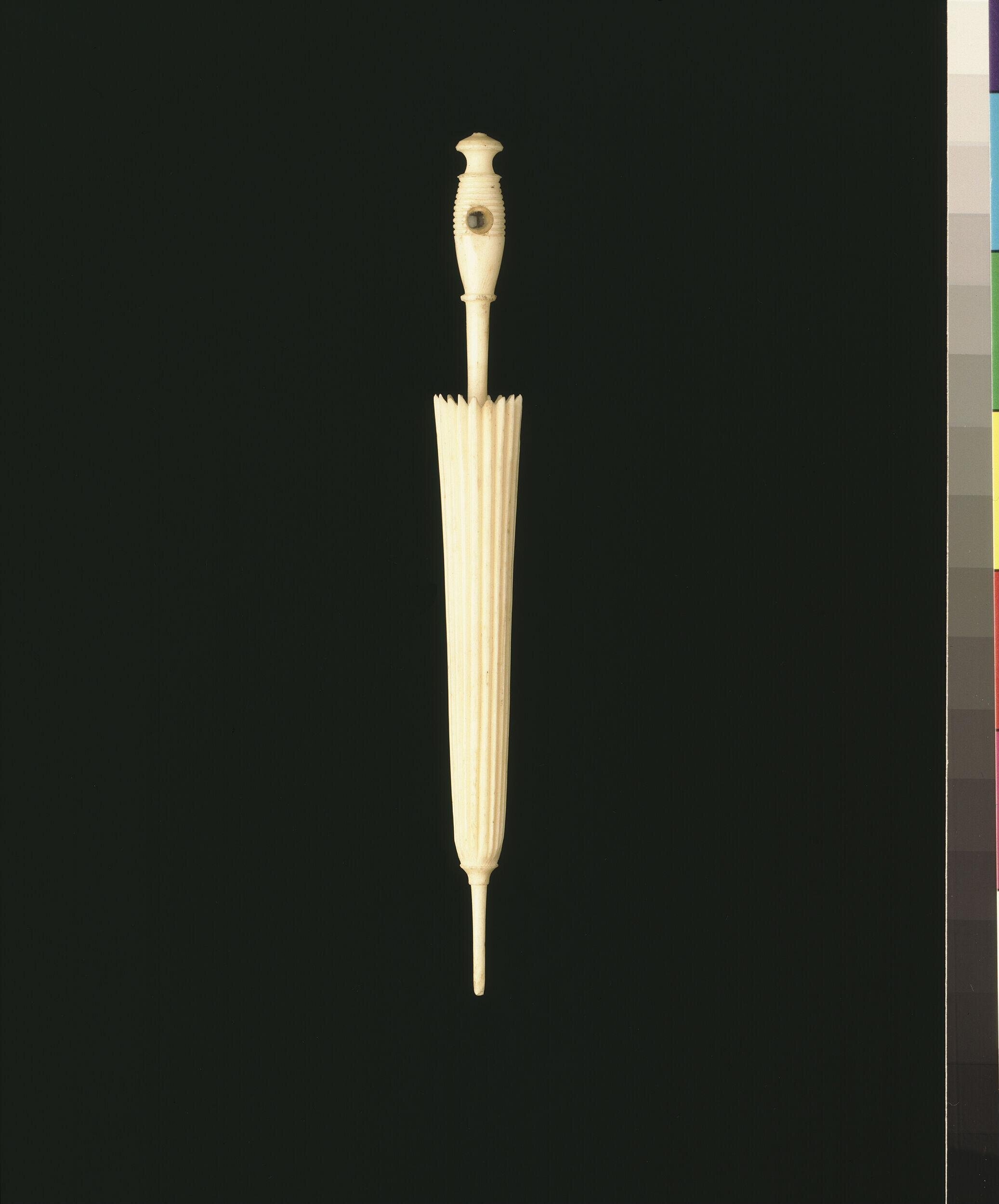
Needle case
Stanhope viewer, carved bone
12.2 x 1.2 cm
Victoria and Albert MuseumTextiles and Fashion Collection, Given by Mr and Mrs Hailey, Accession number: T.238-1969
(Curatorial description, 30 January 2026) This needle case is in the shape of a folded umbrella or parasol. The handle unscrews and there is a hole bored down the centre of the case for the storage of needles. In the handle is a 'Stanhope Viewer', a minute spyglass which shows scenes of famous buildings, resorts, cities or other tourist attractions. In this case it is the Crystal Palace at Sydenham, South London, dating from before 1866 when the tower was burnt down. The image, in the centre of the rod, measures one-thirtieth of an inch in diameter and is seen through the lens (a tiny rod) approximately one-quarter of an inch long and one tenth of an inch in diameter. The end through which the viewer looks is convex in shape to produce high magnification for the very short focal length.
Needle cases were an important component in all 19th century sewing kits. They took many forms and novelties, many becoming collectors' items. Needlework implements with Stanhope viewers include not only needle cases but tape-measure cases and various multi-purpose needlework tools. They were made from the 1860s until the First World War.
Stanhope lenses or viewers were named after the prolific inventor, Charles Stanhope, 3rd Earl of Stanhope (1753-1816). Although Stanhope's lenses made this gadget possible it was not until 1860, when the French chemist Rene Dagron used Frederick Archer's collodian or wet-plate process to make transparent micro-photos on the flat end of the Stanhope viewer, that the invention worked properly.
LL/131743