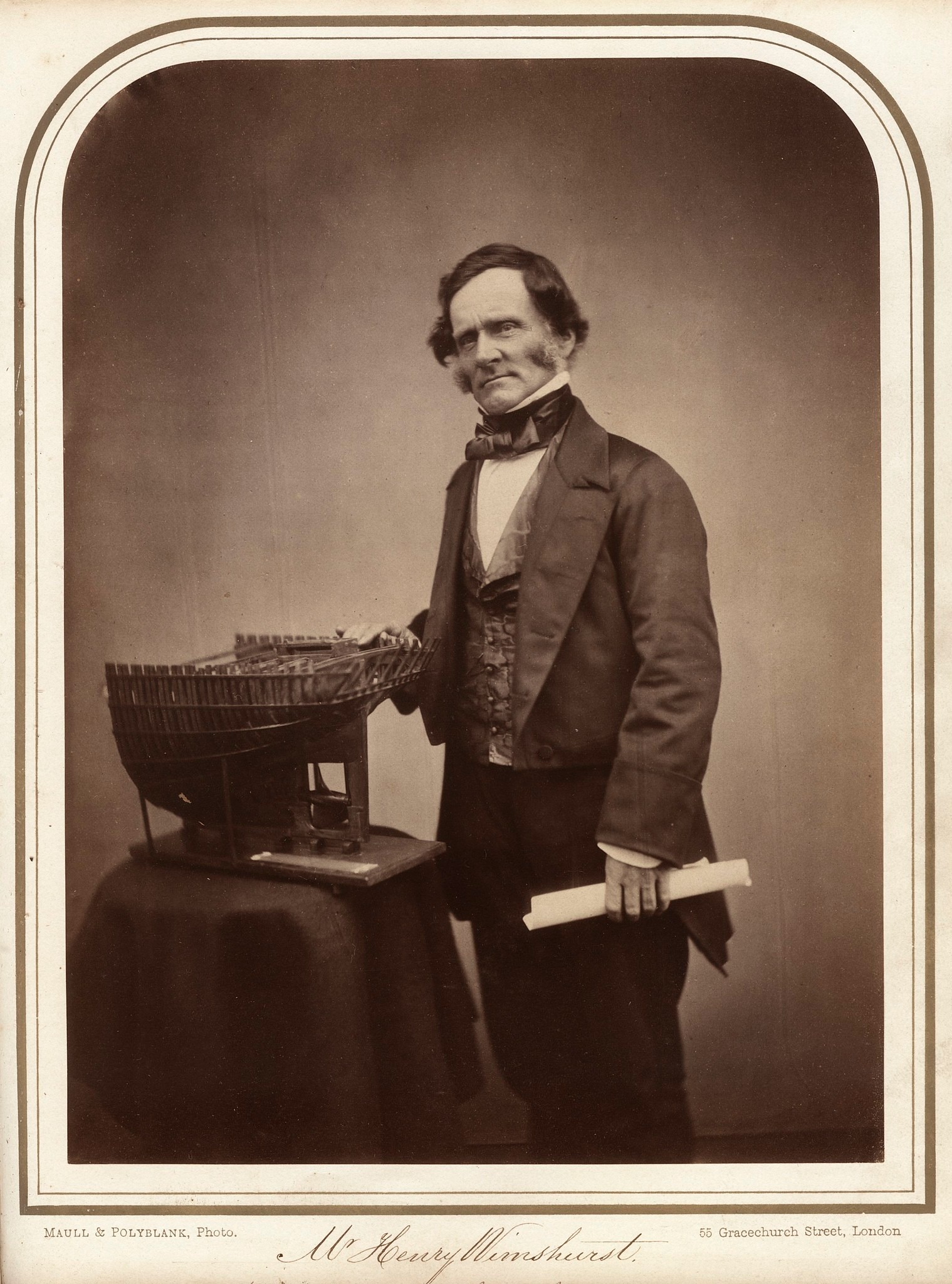
Maull & Polyblank1856Henry Wimhurst
Albumen print8 x 6 in.
Archive FarmsThe Patrick Montgomery Collection, Object No. 2025.257h
Henry Wimhurst (1806–1884) was a pivotal figure in 19th-century maritime history, serving as the practical engineer who bridged the gap between theoretical invention and nautical reality. Based in the bustling shipyards of Limehouse, London, Wimhurst possessed the technical craftsmanship necessary to move shipbuilding away from the limitations of the paddle-wheel and into the era of the modern screw propeller. While others dreamed of the technology, it was in Wimhurst’s yards that these concepts were forged into seaworthy vessels capable of navigating the global stage.
His most enduring legacy remains the construction of the
SS Archimedes in 1839, a vessel that fundamentally altered the course of naval architecture. At a time when the maritime establishment remained deeply skeptical of submerged propulsion, believing it could never match the power of a giant paddle-wheel, Wimhurst collaborated with the patent holder, Francis Pettit Smith. Together, they produced the world’s first steamship successfully driven by a screw propeller. The performance of the Archimedes was so impressive that it compelled Isambard Kingdom Brunel to redesign the SS Great Britain and convinced the Royal Navy to adopt the technology for its future fleet.
Following this landmark success, Wimhurst continued to push the boundaries of maritime engineering with the launch of the
SS Novelty in 1840. This ship served as a milestone for two distinct reasons: it was the first screw-propelled vessel dedicated entirely to commercial cargo, proving the technology's profitability, and it pioneered the use of iron masts. By replacing traditional timber with iron, Wimhurst anticipated the massive material shifts that would define late-Victorian shipbuilding, moving the industry further away from the ancient traditions of wood and wind.
Wimhurst represents the quintessential Victorian engineer, an individual who existed at the crossroads of the ages of wood, iron, steam, and wind. His technical contributions ensured Britain’s naval dominance during a period of rapid industrial transition. This penchant for innovation was clearly a family trait; his son, James Wimhurst, achieved separate fame as the inventor of the Wimshurst influence machine, an electrostatic generator that remains a staple of physics demonstrations to this day.
LL/131806